Davide Boschetto

SENIOR MACHINE LEARNING ENGINEER

Computer vision.
Built for production.

I develop computer vision systems that turn images into useful decisions, from industrial inspection to understanding retail shelves.

At Scandit, I coordinate Scene Parsing work in ShelfView and contribute with my team to the product recognition pipeline. With AI-powered coding agents now part of my workflow, my focus has shifted toward defining problems, directing implementation, and reviewing results, drawing on years of hands-on ML engineering.

Explore selected work ↓LinkedIn ↗
Object detection & recognition2D & 3D classification and segmentationProduction ML systems

01 / SELECTED WORK

Different domains.
The same engineering discipline.

Model development, practical constraints, and the path from data to production.

SCANDIT · SHELFVIEW

Understanding products
on retail shelves

I contribute to the development of the Product Recognitino pipeline for ShelfView, coordinating the detection pipeline and enabling recognizing products in shelf modules.

The work connects computer vision model development with the requirements of a production retail application.

Object detectionRecognitionProduction ML
More about the work +

My focus is building a robust object detector within Scene Parsing. The challenge spans identifying individual products in shelf imagery and supporting product recognition within the broader ShelfView system.

I work with product and data teams to connect model development and evaluation to the application’s needs.
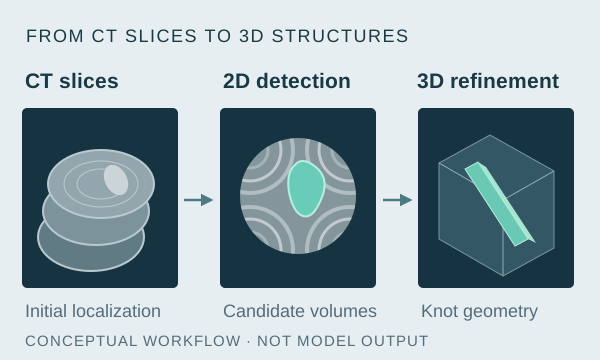
Conceptual workflow: CT slices, initial 2D knot detection, candidate volumes, and 3D refinement. Not model output.

MICROTEC · INDUSTRIAL INSPECTION

Finding knots
in 2D and 3D

At Microtec, I worked on knot segmentation in CT scans of logs, using both 2D images and 3D volumes to identify internal wood structures.

A first model located knots in CT slices. Those predictions guided the extraction of smaller volumes, where a 3D model refined the segmentation for downstream geometric analysis.

2D & 3D segmentationCT imagingU-Net architectures
More about the work +

The pipeline used a custom 2D U-Net for the initial knot segmentation and a custom 3D U-Net with volumetric convolutions for refinement. Downstream algorithms used the resulting masks to infer parametric representations of individual knots.

Training examples came from multiple customers, connecting model development to the variety of wood encountered in industrial scanning. My broader workflow covered data preparation, augmentation, architecture selection, and deployment, balancing precision with production-time constraints.

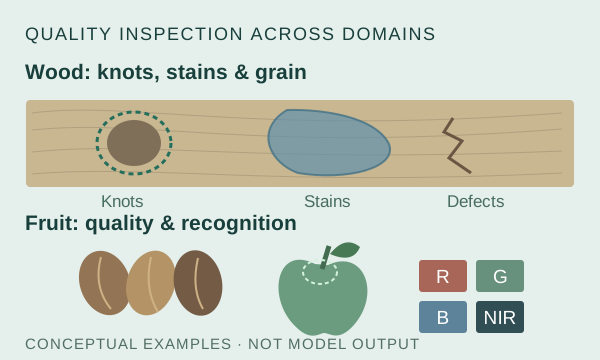
Conceptual wood and fruit inspection: knots, stains, defects, dates, apple stem regions, and RGB and near-infrared inputs. Not model output.

MICROTEC / BIOMETIC · QUALITY INSPECTION

Inspecting wood
and fruit quality

I worked on models for wood and fruit inspection: segmenting knots and stains, classifying wood grain, and assessing fruit quality from image data.

The applications called for different formulations of the problem, from pixel-level defect masks on boards to classifications of individual fruit views or whole fruits. Networks I trained entered production from early 2018.

ClassificationSegmentationRGB & near-infrared
More about the work +

For lumber, the work included knot and stain segmentation on dry boards and lengthwise grain classification. I also explored multi-defect segmentation on longitudinal scanners using RGB, laser-scatter, 3D, and X-ray inputs. These multi-defect experiments were exploratory at the time of the presentation.

For dates, the tasks included quality sorting, ripeness, and fungus classification using RGB and near-infrared imagery. Apple inspection distinguished good stems, cracked stems, and calyx regions. This connected visual recognition to practical quality decisions, with data collected and labeled alongside domain specialists.

02 / EXPERIENCE

Models are one part.
The system matters too.

Hands-on ML development alongside ownership of the tools and processes that support it that enable everyone in the company to generate meaningful impact.

2022 — PRESENT

Scandit

Senior Machine Learning Engineer

Coordinating Scene Parsing work and contributing to the product recognition pipeline for ShelfView. Since adopting Claude at Scandit, my day-to-day work has shifted toward directing coding agents: framing tasks, guiding technical decisions, and reviewing their output. I bring hands-on ML experience to that process and remain accountable for the quality of the resulting work.

2017 — 2022

Microtec / Biometic

Deep Learning Specialist

Developed neural networks for industrial inspection, from data preparation through deployment.

Training framework leadership, 2020–2022 +

As project lead, I developed the shared company framework for training neural networks. It standardized internal data formats, architecture development, training workflows, and model deployment into scanners.

The framework supported classification, segmentation, and regression, with local or training-server execution using Docker and Jenkins. It was used across Microtec and Biometic.

2018

Hawk-Eye Innovations

Freelance Computer Vision Engineer

A consulting engagement alongside my Microtec role, focused on segmentation and video matting.

2016 — 2017

Previnet

R&D Data Scientist

Healthcare-focused analytics and software engineering, including real-time data processing and medical text analysis.

03 / EXPERTISE

From training data to deployment.

01

Computer vision

Detection, recognition, classification, and semantic segmentation in 2D images and 3D volumes.

PyTorch · TensorFlow · Keras

02

Production engineering

Reusable training workflows, data standardization, model evaluation, and deployment integration.

Python · Docker · CI/CD

03

AI-assisted technical leadership

Translating engineering goals into well-defined tasks for coding agents, directing their work, and applying technical judgment to review and refine the results.

Claude · Agent orchestration · Technical review

04 / RESEARCH & EDUCATION

A foundation
in image analysis.

My PhD research explored computer-aided analysis of confocal endomicroscopy images, using engineered features and random forests for segmentation and classification.

Publications on Google Scholar ↗

2013 — 2016 · IMT LUCCA

PhD in Image Analysis

Computer, Decision and Systems Science

2009 — 2012 · UNIVERSITY OF PADUA

MSc in Bioengineering

Thesis on compressed sensing in DSC-MRI

ISBI 2016

AIDA-E Challenge winner

Chromoendoscopy image analysis competition

LET’S CONNECT

Discussing a role
in machine learning?

For professional opportunities and conversations, you can reach me on LinkedIn.

Connect on LinkedIn ↗